Dec 2007

3 Courses, 1 Block

Some days The Astronomer and I have a clear idea what we want for lunch. And other days, we sorta wander around knowing that we’ll eventually stumble upon something awesome. Yesterday was one of those “let’s see what we find” kind of days.

Appetizer: Goi Tom Thit (6,000 VND)

As we meandered down the 160 block of Ly Chinh Thang Street in District 3, a vendor selling goi caught my eye. I usually have to head to snack shacks for goi because very few street food vendors sell it in town. I ordered a plate for myself and one for The Astronomer and we sat down on little red stools in the shade to wait for our food. The goi consisted of shredded green papaya topped with fried shallots, pickled shallots, chopped basil, a cooked shrimp, toasted peanuts, sliced pig’s ears and nuoc cham. The chewy cartilage coupled with the nuoc cham drenched papaya was a mild, yet refreshing combination. If you’ve never tried pig’s ears, what are you waiting for?

Intermezzo: Khoai Lan Chien (4,000 VND)

As we finished up our salads, a woman selling deep fried goodies rolled her cart our way. The Astronomer ordered a small bundle of lightly battered sweet potato fries to cleanse our palettes. The fries came fresh out of the hot oil and were beautifully crisp and golden. A little salt would have set off the potato’s sweetness nicely.

Entree: Bun Thit Nuong Cha Gio (10,000 VND)

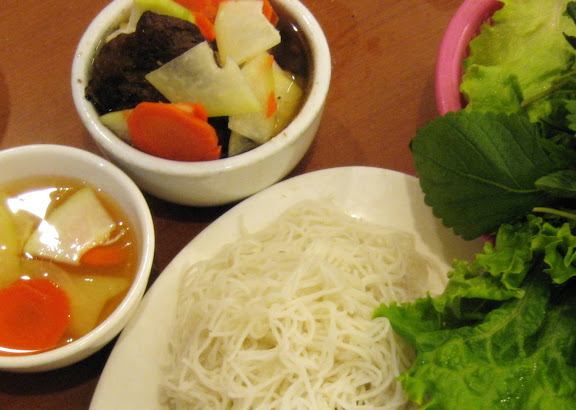
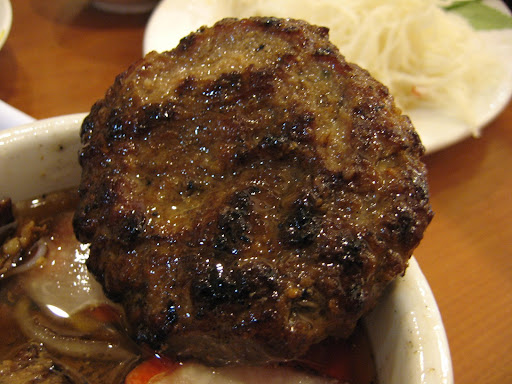
For our third course, we walked five steps to a nearby vendor dishing up bun thit nuong cha goi. She generously loaded up our bowls with a bundle of fresh vermicelli noodles, grilled meat, egg rolls, basil, romaine lettuce, fried shallots and the ever-present nuoc cham sauce. Even though the noodles slightly adhered to one another, it was a solid bowl of bun.

For dessert we headed back to Tu Xuong Street to visit our favorite che dau hu vendor.

Oh, life is so delicious.

Dec 2007

Vegetation Profile: Khoai Mỡ

Dioscorea alata, called water yam, winged yam, and purple yam, was first cultivated somewhere in Southeast Asia. Although it is not grown in the same quantities as the African yams it has the largest distribution world-wide of any cultivated yam, being grown in Asia, the Pacific islands, Africa, and the West Indies (Mignouna 2003). In the United States it has become an invasive species in some Southern states.

In the Philippines it is known as ube (or ubi) and is used as an ingredient in many sweet desserts. In India, it is known as ratalu or violet yam or the Moraga Surprise. In Hawaii it is known as uhi. Uhi was brought to Hawaii by the early Polynesian settlers and became a major crop in the 1800s when the tubers were sold to visiting ships as an easily stored food supply for their voyages (White 2003).

Known as khoai mỡ in Vietnam, this yam is used in both sweet and savory dishes. My encounters with khoai mỡ have been pretty limited thus far. I once ordered a cup of che thap cam at Che 278 in District 4 that featured a layer of sweetened khoai mỡ puree. However, now that I know what this purple vegetable is, I’ll be on the lookout for it on menus around town.

According to my mom, the most common preparation of khoai mỡ is in a shrimpy soup called canh khoai mỡ. Coincidentally, The Astronomer recently noticed the owners of one of his favorite bun cha joints slurping down a strange purple broth for their dinner. When he asked what it was, they ladled out an extra bowl for him and invited him to sit down. The soup turned out to be canh khoai mỡ, which he described as “plain.” My mom, on the other hand, couldn’t stop raving about the soup’s deliciousness when I spoke to her. So, I can’t wait to try the yam soup for myself!

Dec 2007

Me

While in Phu Quoc, I procured some Vietnamese tamarind candies called me. It was an impulsive junk food purchase, but that’s what vacations are for. I bought a quarter kilogram for 5,000 VND and pretty much finished them the same day because they’re mighty addictive.

The me‘s exterior is covered in coarse sugar crystals and dried chili flakes. The center contains a glossy seed that easily separates from the edible flesh.

The candy initially registers as sweet, but quickly transitions to spicy. The only way to stop my mouth from burning is to pop in another candy to bring my taste buds back to sweet. I guess that’s how I finish them up so quickly!

If you’re a fan of Mexican tamarind candies like Pelon Pelo Rico, this is definitely up your alley.