Oct 2008

Pavlova Pyatt

Food blogs, food sections and food writing are wonderful sources of inspiration and entertainment for me and countless others. While writing about Jaspa’s pavlova the other evening, something unexpected happened—I became my own  source of inspiration. Reminiscing about my first pavlova got my creative juices flowing and I was determined to re-create the Aussie/Kiwi magic in my own home. In the words of Miss Adventure, ta da!

For pavlova

  • 6 large egg whites
  • 1 1/2 cups superfine granulated sugar
  • 1 1/2 teaspoons cornstarch
  • 1 teaspoon distilled white vinegar
  • 1/2 teaspoon vanilla
  • 1/4 cup boiling water

For topping

  • 1 cup heavy cream
  • 3 cups assorted seasonal fruit such as raspberries and sliced strawberries and kiwifruit

Preheat oven to 350° F. and line a large baking sheet with foil.

IMG_2690

In a large bowl with an electric mixer beat together whites, sugar, cornstarch, vinegar, and vanilla on low speed until just combined. Add boiling water all at once and beat on high speed 3 to 5 minutes, or until mixture forms stiff, glossy peaks.

IMG_2695

IMG_2698 IMG_2697

IMG_2702

Spoon meringue mixture onto baking sheet and spread into a 9- to 10-inch circle.

IMG_2709

IMG_2703 IMG_2708

Bake Pavlova in middle of oven 10 minutes. Reduce temperature to 200° F. and bake Pavlova 40 minutes more. Turn off oven and let Pavlova stand in oven 1 hour. Transfer Pavlova to a rack and cool completely. (Pavlova will be hard on outer surface and soft inside.)

IMG_2734

In a bowl with cleaned beaters beat cream until it holds soft peaks and spread over Pavlova. Mound fruit on top of whipped cream.

Makes 6 to 8 servings.

Gourmet, April 1998

(more…)

Oct 2008

Jaspa's – Ho Chi Minh City

My editor in Saigon, an Aussie named Fiona, broadened my culinary horizons during our brief but wonderful publishing days together. She introduced me to eating passion fruits straight up—awesome, Vegemite—not so awesome, and pavlova—wooooot! Fiona grew up eating pavlovas and was shocked to hear that I had never heard of or sampled one of her country’s classic eats.

Pavlova is a meringue dessert named after the Russian ballet dancer, Ánna Pávlova (Russian: А́нна Па́влова). It is referred to colloquially as ‘pav’. The dessert is crispy on the outside but light and fluffy inside. The dessert is believed to have been created to honor the dancer during or after one of her tours to Australia and New Zealand. The exact location of its first creation and the nationality of its creator has been a source of argument between the two countries for many years, however more serious research into the matter indicates New Zealand as source of today’s pavlova. The dessert is a popular dish and an important part of the national cuisine of both countries, and is frequently eaten during celebratory or holiday meals such as Christmas dinner.

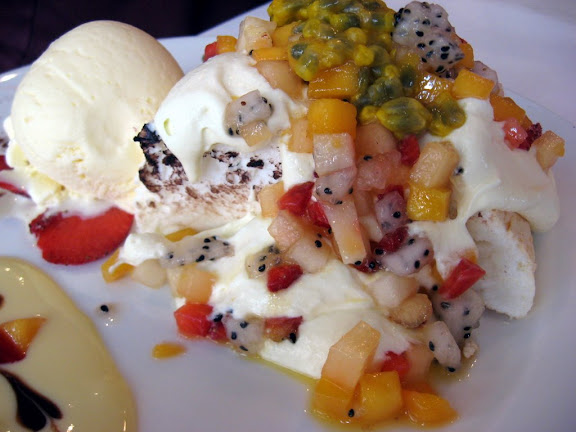
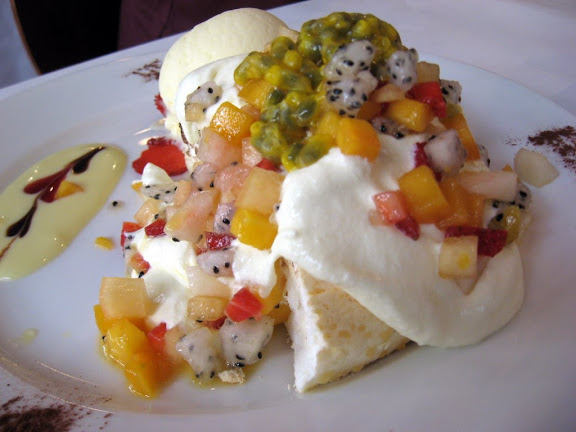
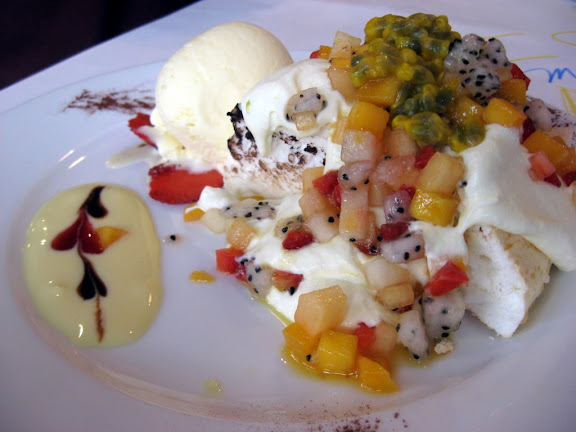
Curious as heck as to what the fuss over pavlovas was all about, The Astronomer, Nina and I headed to Jaspa’s, a Saigon eatery specializing in Aussie fare, to taste our very first pav. The dessert arrived decadently adorned with diced fresh fruits (passion fruit, watermelon, dragon fruit, mangoes), whipped cream, a scoop of vanilla ice cream and creme anglaise.

The texture of the room temperature pavlova was crisp on the outside and marshmallow-y inside. The tart fruits and creamy accoutrement were easy on the eyes and taste buds. The dessert is sweet, but the fresh fruits reel it in, keeping the pavlova from feeling heavy.

I’m not sure what you’re doing this weekend, but I’m gonna try my hand at making pavlova. Who’s in?


Jaspa’s
33 Dong Khoi Street
District 1, Ho Chi Minh City
Phone: 08 822 9926