Bap
Sep 2008

Bắp Chiên

A couple months back, I posted an entry about a savory snack called nui chien that the queen of salty bites, Miss Adventure, introduced me to. Reader and Saigon resident Dave suggested in the comments section of that post that I seek out a similar snack called bap chien or “fried corn” that he and his gal pal were big fans of.

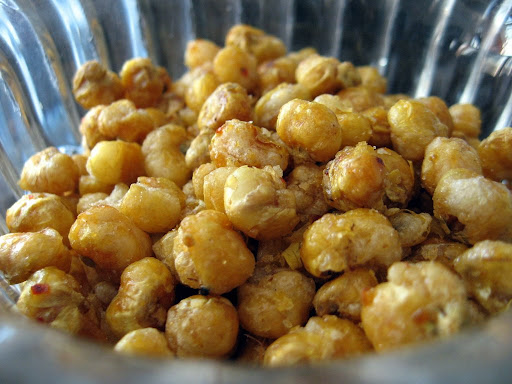
While stocking up on nui chien at the local Maximark on Hai Ba Trung, I remembered Dave’s recommendation and picked up a bag of bap chien. As soon as I arrived back at the apartment, I busted out the bap chien for a highly anticipated taste test. As Dave promised, the bap chien were addictively crunchy. The bap chien initially register as salty, but end on an unexpected sweet note. 

Salty. Sweet. Salty. Sweet. Kind of like kettle corn. I liked them so much that I nearly ate the whole bag in one sitting. I managed to rationalize it to myself by saying that I went two whole years without consuming a single corn nut while wearing braces in middle school. Clearly, I was just making up for lost time.

Sep 2008

Vegetation Profile: Calabash Tree Fruit

mystery fruit

Back in May, I posted this picture and gave the following description:

I encountered this vegetation in Ho Tram and have no idea what it is. I’ve asked a couple of locals, but they were just as clueless as yours truly. One guy said it was related to gac fruit. All I know is that it’s hard, larger than a softball, heavier than it looks and definitely not a pomelo. Can anyone identify what fruit or vegetable this is?

I received a number of guesses from helpful readers, but no one hit the nail on the head. That is until Anh chimed in. “It looks like Trái Đào Tiên,” she wrote. “It belongs to the same family with Pomelo. Vietnamese use it as a medicine.” Ding ding!

After a bit of research using this pertinent new information, I discovered that the scientific name for the tree is Crescentia and that it is “a genus of six species of flowering plants in the family Bignoniaceae, native to southern Florida, the Caribbean, southern Mexico, Central America and northern South America. The species are small trees growing to 10 meters tall, and producing large spherical fruits up to half a meter in diameter.” I also learned that the Vietnamese use the dried Calabash fruit to cure such ailments as asthma and diarrhea.

Thank you, Anh. I’m so glad we have finally identified this mystery fruit. Woot!

Sep 2008

Bánh Xu Xê

An alien’s breast implant or a Vietnamese dessert? If you guessed the former, you’ve got a wicked sense of humor, but are unfortunately incorrect. What you’re looking at is banh xu xe—a Vietnamese sweet with a jelly-like texture made of tapioca flour, pandan, mung bean paste, sugar, sesame seeds and coconut milk.

This one time, I left a banh xu xe in my messenger bag unknowingly for over a week and as a result, it grew fuzzy with mold. The day I discovered it at the bottom of my bag, I asked my colleague Chris at the AsiaLIFE office if I could please pelt him with it. Believe it or not, he said yes. I wound up softball-style and pitched it at him with all of my might. As anticipated, the banh xu xe exploded upon contact! God, it feels so good being a small child sometimes.

The bottom line—banh xu xe are interesting to look at, but lack substance and flavor. At 1,000 VND a piece, I suggest you buy a dozen and pelt them at your friends to show them how much you care. To satisfy that pandan-flavored, jelly-textured, mung bean-filled craving, eat banh da lon.