Aug 2008

Bánh Tráng Trộn

Banh trang tron is a hodge-podge salad-type creation that I’ve only encountered in street food form. Whereas most of Saigon’s pavement eats are sold on some sort of rolling metal cart, banh trang tron is sold exclusively by conical hat-donning women carrying weighty baskets over their shoulders.

The surest sign that you’ve stumbled upon a banh trang tron dealer is the small hoard of business suit-clad women crouching around her baskets waiting for their take of the stuff.

The base of the dish is banh trang (rice paper), which are cut into strips and kept dry as a bone. A packet of flavoring agents that includes chili powder and MSG are added to the banh trang strips. Next, an abundance of fresh rau ram (Vietnamese coriander) is torn into the mix, followed by a squeeze of sour Vietnamese kalamansi juice and hard boiled quail eggs. The vendor combines (tron) the ingredients with her hands and serves up a portion in a plastic bag with two skewers serving as makeshift chopsticks.

Even though banh trang tron is a painfully dry dish, it manages to meld all of the ingredients into a cohesive flavor. Although edible, it’s just not all that appealing, especially the clumps of chili powder. The Astronomer conjectures that this dish was thought up during an era of extreme poverty to spruce up plain old rice paper. I think he may be on to something.

Aug 2008

26.2 Miles & Asiana Airlines

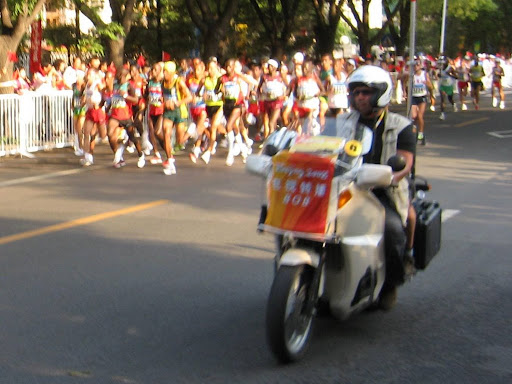
On our final morning in Beijing, The Astronomer woke up super-early to catch the men’s marathon. I was wiped out after a late evening of track and field and chose to sleep in before boarding our trans-Pacific flight. I know, I’m weak. The Astronomer caught the pack of runners at three different points along the course. Here they are around four minutes into the race. The lead pack cleared the first mile in 4:41. Insanity!

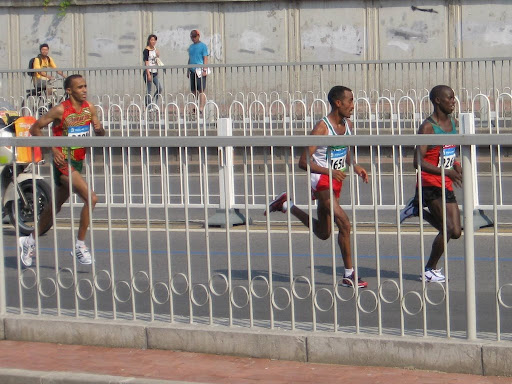
The conditions on race day were 74 degrees in the shade and 84 degrees on the course. Here are the leaders 36 kilometers into the race (six kilometers left). Sammy Wanjiru of Kenya is in first at this point, and he pulled away to win in a time of 2:06:32. What pollution?

After playing groupie, The Astronomer returned to the hotel and we got in our own (much slower) run and then headed off to the airport.

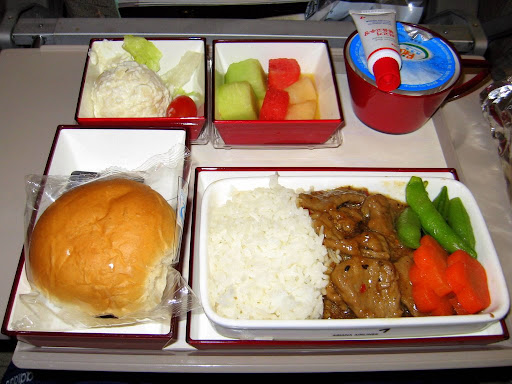
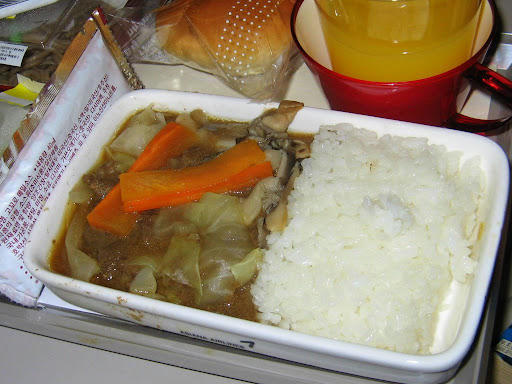
On the first leg of our flight from Beijing to Seoul, we were served beef with rice, peas and carrots. Side items included a roll, butter, potato salad, fruit salad and a tube of Korean chili paste. Although it’s hard to tell from the picture, the portion of beef seemed quite generous.  Our idea of what constitutes a proper protein portion has been forever distorted after residing in Vietnam for a year. We thought this meal was on par with the ones we’ve eaten on United and Cathay Pacific—solid airplane fare.


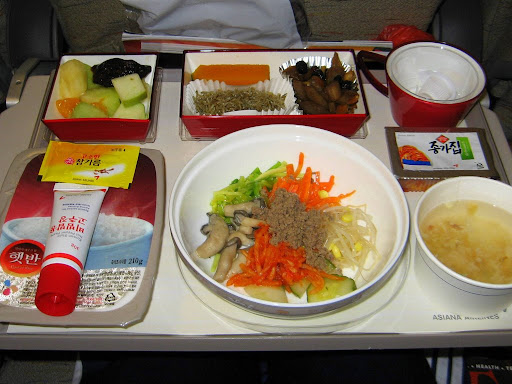
Before leaving us alone to watch movies and pass out on the second leg of our flight from Seoul to LAX, the stewardesses served dinner. Our choices were Korean or Western. The Astronomer and I had one of each—Korean for her and Western for him. I think it’s so wonderfully cool that Asiana serves bi bim bap on board. Imagine if Vietnam Airlines served pho. Wouldn’t that be a trip (literally and figuratively)? The bi bim bap came with a little fold-out note card instructing fliers in English, Chinese and Korean how to assemble and eat it. I saved the foldout because it was just too precious to throw away with the garbage.

The instructions advised me to add the hot rice to the beef and vegetable mixture first. Then, I squirted Korean chili paste on top. Lastly, I mixed it all together well. The instructions suggested that I eat the bi bim bap with the hot soup and the banchan (kimchi, burdock with peanuts and tiny salty dried fishes), which I did. The bi bim bap was probably the best thing I’ve ever eaten on board a plane.

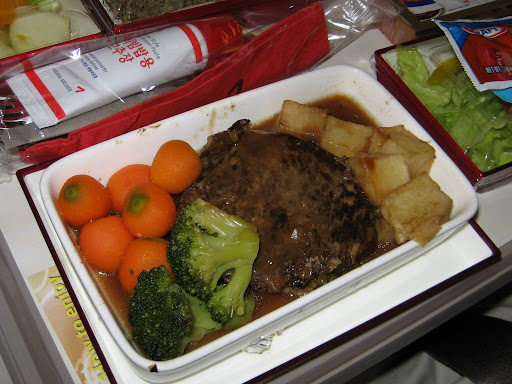
The Astronomer’s Western steak and potatoes didn’t come close to matching the awesomeness of my bi bim bap. The steak was anti-tender, but The Astronomer said the sauce was good. Suuuure.  

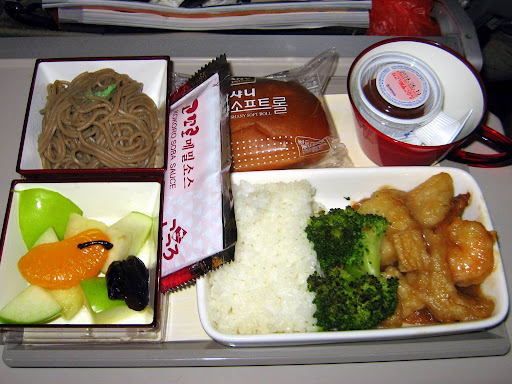
Eight hours later (two hours before landing at LAX), we were served a final meal. I chose the crispy fried seafood, which wasn’t so crispy by the time it arrived in front of me. The soba noodles with wasabi weren’t the least bit gluey, and they actually tasted quite good! What’s cool about flying on a non-American airline is that soba noodles are considered a perfectly normal thing to serve on board. Love that!

The Astronomer went for the “bulgogi” for his final meal. It tasted exactly like the beef and rice dish we were served from Beijing to Seoul. Before we knew it, we were back on American soil. Unbelievable!

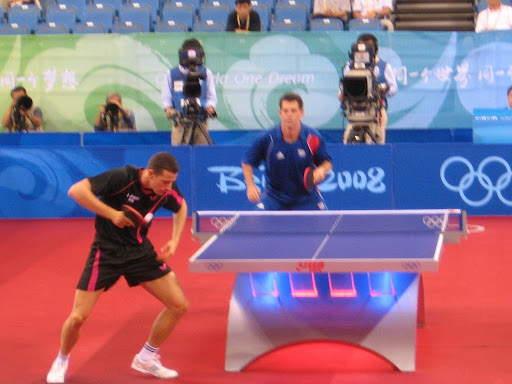
And because reader Nate inquired, here’s some ping pong action from Day 2 in Beijing. The Astronomer and I were rooting for the French dude in blue because he looked like a dad and had a little beer belly. Too bad he lost to the ultra-fit eastern European. Give the old man a break! 

Aug 2008

Farewell Fuwa*

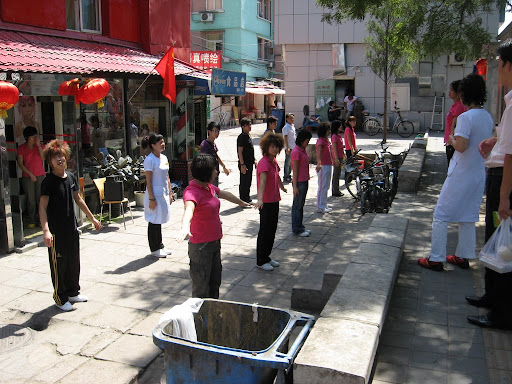
My last full day in Beijing started with a warm soy milk and an egg McMao sandwich from the bread outlet on Third Ring Road. The bread place is located a few doors down from a hair salon. Every morning during our stay in Beijing, The Astronomer and I watched as the hair stylists performed their daily hand/eye/aerobic exercises. Whereas the women in Saigon are full of energy when they work out, these Beijingers were an unenthusiastic bunch.
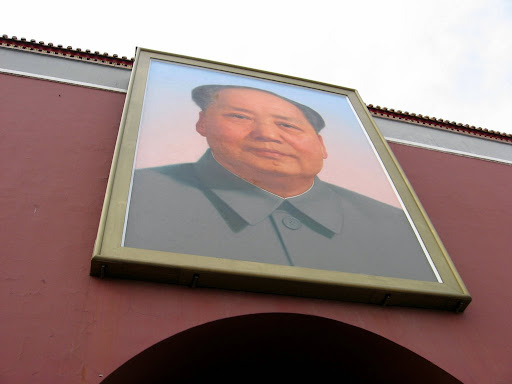
Peking Duck? Check. Silk Road? Check. The Great Wall? Check. We saved visting the Forbidden City for last.

The Forbidden Citywas the Chinese imperial palace from the mid-Ming Dynasty to the end of the Qing Dynasty. For almost five centuries, it served as the home of the Emperor and his household, as well as the ceremonial and political centre of Chinese government. Built from 1406 to 1420, the complex consists of 980 surviving buildings with 8,707 bays of rooms and covers 720,000 square metres. The palace complex exemplifies traditional Chinese palatial architecture, and has influenced cultural and architectural developments in East Asia and elsewhere.
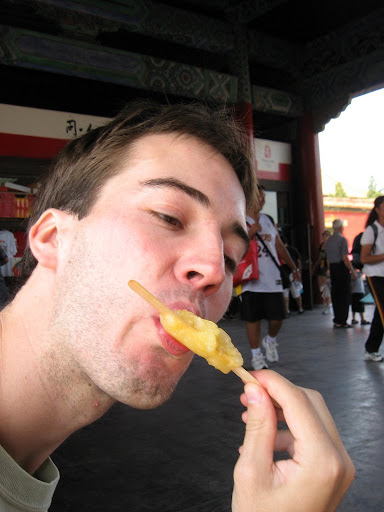
The Astronomer and I enjoyed the Forbidden City, but weren’t blown away by it. It seems that after a year of living in Asia, we’ve become desensitized to this type of architecture. Granted, the Chinese invented this style of architecture, but at the end of the day, it was “same, same” in our book. The Forbidden City was scorching when we visited, so this peach icy popcicle (3 RMB) was crucial to our survival.
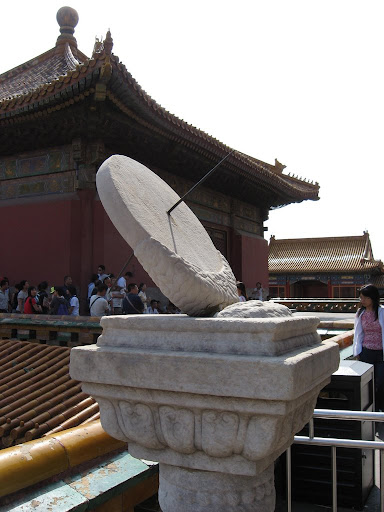
Ancient sundial.
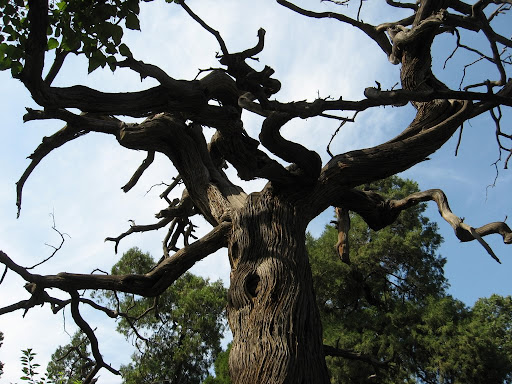
 Nature making wonderful use of negative space.
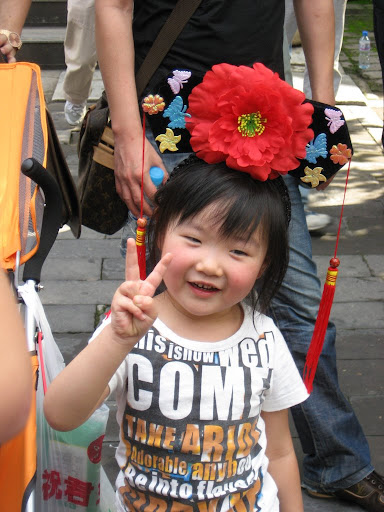
Local tourists were keen on buying these faux royal head dresses for their little girls. They reminded me of the characters from the Chinese movies—the ones that come in sets of 50 VHS tapes—that my grandmother loves with all of her heart.  

After a couple of hours exploring the Forbidden City, we shopped for Olympic merchandise at the flagship store nearby. While I think Black Friday is a blast, the crowds here were much too much! We picked up a few items for our loved ones back home and then headed down to the basement food court for dinner.
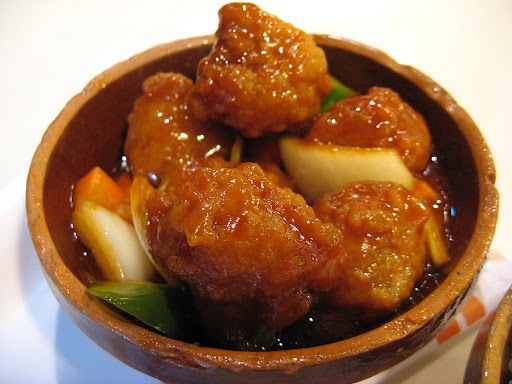
 After two weeks of bravely holding out, The Astronomer finally gave in and chose the most sesame chicken-like item he could find. The texture of the sauce and chicken pieces were spot-on, but the flavor lacked the sweet and sticky punch that’s characteristic of Chinese-American hits like sesame chicken, General Tso’s chicken and orange chicken. It was also kinda cold. Unforgivable.
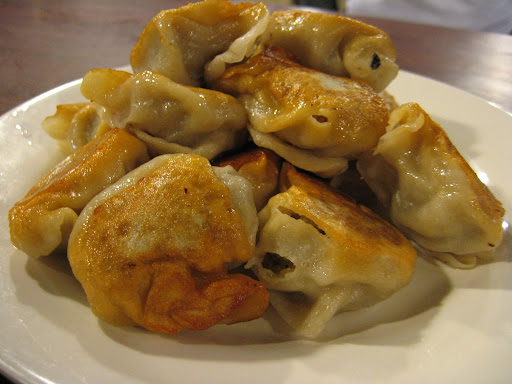
The pan fried dumplings were excellent, except that The Astronomer chose the celery and pork ones (and everyone knows celery is sort of inferior).
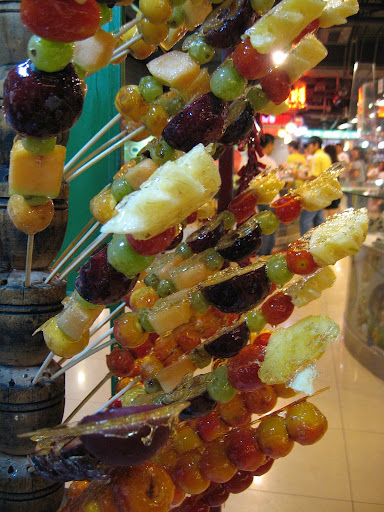
I couldn’t leave Beijing without indulging in one more stick of candied fruit. This time around I chose a mixed-fruit variety with pineapples, tomatoes (!), grapes, plums and crab apples. To encourage more Americas to consume fresh fruit, I highly advocate candy coating.
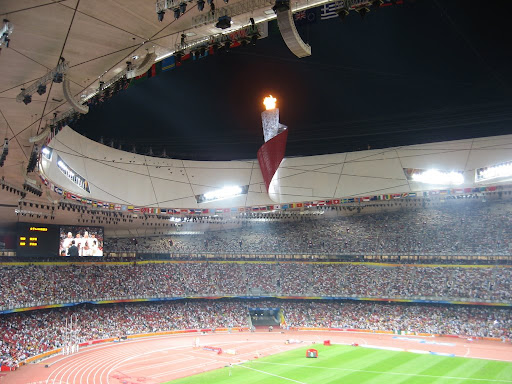
After our food court dinner, The Astronomer and I rushed to the Bird’s Nest for the last evening of Track and Field action. This time around, we sat on the stretch of track facing the torch and the finish line. We were also seated next to a bunch of Americans so it was good times, especially when the women’s and men’s 4×400 teams took home gold. The group of Finns behind us were the most enthusiastic javelin fans we’d ever met.
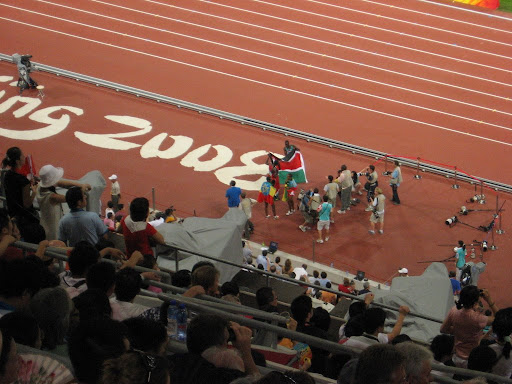
Victorious Kenyan and Ethiopian runners after the 5K. It’s too bad that track stars are only elevated to super-star status once every four years.
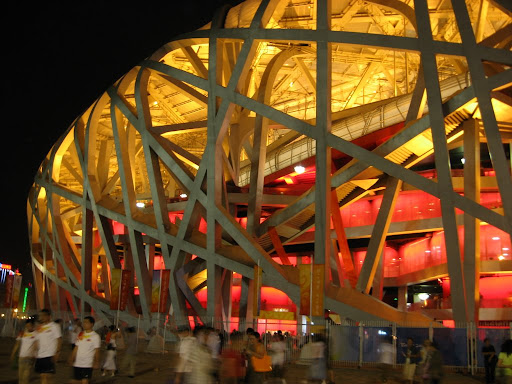
Goodbye, Bird’s Nest. You are a damn sweet piece of architecture. Don’t get rusty while I’m gone.

*The Fuwa are the mascots of the 2008 Summer Olympics in Beijing. The designs were created by Han Meilin, a famous Chinese artist. There are five fuwa: Beibei, Jingjing, Huanhuan, Yingying, and Nini. Together, the names form the sentence “Běijīng huānyíng nǐ,” which means “Beijing welcomes you.” Originally named ‘The Friendlies,’ they were promoted as ‘Fuwa’ when there were concerns the name could be misinterpreted.