
May 2009

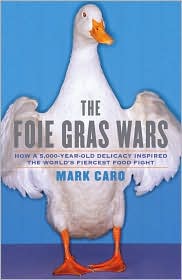
The Foie Gras Wars – Mark Caro

About: Veteran Chicago Tribune entertainment reporter Caro expands on his front-page story about a 2005 flap over foie gras with a wide-ranging investigation into the ethical debate surrounding the human consumption of fattened duck liver. Drawing on conflicts in Chicago, Philadelphia and California over whether force-feeding birds should be legislated as torture or standard agricultural practice, Caro presents various positions from duck farmers, chefs and animal rights activists. His chatty arguments between industry players deliver without becoming unnecessarily complicated or resorting to the oversimplification of surveys and superficial media reports. Caro offers descriptions of a vegan activist headquarters, a video depicting a rat burrowing into an injured duck, and traditional farm operations in France. While he pursues his source’s agendas with due diligence, he appears reluctant to side completely with gourmands despite describing presumably happy ducks, mouthwatering foie gras meals and even eating a raw duck liver. While he tends to focus on the colorful, entertaining aspects of the food’s history and science, Caro’s selection of pointed quotes from duck liver lovers and foie gras foes presents an in-depth take on this ongoing food fight. From Publishers Weekly.

My Thoughts: I snatched up The Foie Gras Wars on the New Non-Fiction bookshelf at my local library. While it was the sensationalist title that initially caught my eye, Caro’s personable style of writing drew me in and kept me interested from start to finish. I appreciated how Caro’s background as an entertainment reporter distinguished his voice and style from the Michael Pollans and Marion Nestles of the food politics writing world.

As a semi-frequent fine diner and full-time news media hound, I’ve read bits and pieces here and there about the controversy over foie gras. I was well aware that the substance was banned for a period of time in Chicago and that Philadelphians were considering similar legislation, but I never understood the full picture until reading this book. I was really surprised to discover that it was Charlie Trotter who started this whole messy foie gras war. Not cool Chaz, not cool at all.

Some of the funniest parts of The Foie Gras Wars looked at the lengths Chicago chefs went to in order to serve the illegal substance. From giving it away gratis to establishing membership-only secret clubs, foie gras never really disapeared from the city’s fine dining scene. On the Philly front, cranky old Georges Perrier‘s (of Le Bec-Fin fame) tit for tat with the animal rights group Hugs for Puppies was a riot as well.

Aside from examining the politics and personalities behind the battle lines, Caro also paid a visit to a few of the U.S.’s major foie gras farms, including Hudson Valley Foie Gras and Sonoma Foie Gras, to witness gavage (force-feeding) firsthand. Although Caro doesn’t outwardly state whether or not he feels that foie gras production is cruel, from his tone and words, I gathered that he’s more for than against.

After reading Caro’s detailed accounts of gavage in both North America and in France, I remain comfortable consuming foie gras. However, I must admit that the images that surface from Googling ‘gavage, foie gras’ makes my stomach turn slightly.

Click below to watch Chef Dan Barber of Blue Hill and Blue Hill at Stone Barns discuss the potential for natural foie gras—it’s awesome. Thanks again, Vanessa!
(more…)

May 2009

Bulgarini Gelato – Altadena

BULGARINI GELATO

Bulgarini Gelato came across my radar via a post on Serious Eats titled, I Ate L.A. by Daniel Zemans.

On a quick trip to the City of Angels, this muy serioso eater tore up the local cheap eats scene with feedings at Yum Yum Doughnuts, Apple Pan, Stan’s Donuts, Bulgarini Gelato, Diddy Riese, Pizzeria Mozza, Kogi, Philippe’s, Cielito Lindo, Fugetsu-Do Confectioneries, A-Won, Los Balcones Del Peru, Mashti Malone’s, Roscoe’s House of Chicken and Waffles, Chicken Itza, and Langer’s Deli.


After gorging his way through our fair city, Zemans proclaimed with confidence, “Bulgarini’s gelato was the best thing I ate on my trip.”

On an awesomely hot Sunday afternoon in April, The Astronomer, Laurie, and I hoofed it to the boonies to see if Altadena’s Bulgarini was really the cat’s meow. We each ordered smalls ($3.85), which allowed us to choose three different flavors. From the selection of fifteen gelatos, granitas, and sorbets available, I chose scoops of cherimoya, strawberry, and almond.

Of the three, the almond gelato was the most spectacular due to its intense nuttiness and sandy, yet creamy texture. The cherimoya gelato, with its fleeting but satisfying tropical sweetness, was a delightful number as well. However, its soft texture couldn’t stand up to the brutal San Gabriel heat. The strawberry sorbet was my least favorite of the trio due to its icy mouth-feel. The artisanal gelato makers at Philadelphia’s famed Capogiro produce amazing fat-free sorbets that are out-of-this-world creamy.

Laurie went for scoops of almond, coffee, and dark chocolate. She liked the coffee and chocolate, but she loved the almond. Whereas coffee ice cream usually tastes super-sweet like Vietnamese ca phe sua da, Bulgarini’s coffee flavored gelato tasted of freshly brewed black coffee.

The Astronomer chose scoops of cherimoya, strawberry with chili powder, and pineapple. Even with its icy texture, the strawberry chili was sensational, with an appealingly peppery kick. The pineapple tasted dull next to the sexy strawberry, but that’s to be expected.

I returned to Bulgarini a week later with my lovely friend Esme. We studied abroad together in Rome during college and have consumed copious amounts of gelato together throughout the years. On our visit, we settled on scoops of almond (of course!), orange chocolate, and almond chocolate. The almond gelato was as terrific on this visit as it was on the previous one. The almond chocolate was wonderful as well, combining the almond’s winning nuttiness with deep dark chocolaty richness. The orange chocolate captured the essence of orangettes in gelato form. The only addition that would’ve made it even tastier would have been actual bits of candied orange peels.

Bulgarini Gelato
749 E. Altadena Drive
Altadena, CA 91001
Phone: 626-791-6174

May 2009

Aladin Sweets & Market – Los Angeles

There are only four words in the English dictionary that are short, sweet, and crass enough to aptly describe dining out with Tony C:

Balls. To. The. Wall.

Inspired in part by a piece in the New York Times titled, Koreans and Bangladeshis Vie in Los Angeles District, Tony C. spearheaded a Bangladeshi feast at Aladin Sweets & Market. Attendees included me, The Astronomer, Laurie, and Ani P., a Yelper and Bangladeshi food expert whom Tony C. coerced into showing us the ropes. Thanks again, Ani!

Aladin Sweets & Market, which is one of Ani P.’s favorite Bangladeshi eateries, is divided into three distinct sections. A canteen-style lunch counter brimming with goodness greets patrons as they walk through the front door. The prepared foodstuffs here can be eaten in house or packed to-go. To the left of the main entrance is a small dining room and an even smaller market. The market carries a selection of Bangladeshi, Burmese, Indian, and Pakistani spices, groceries, frozen fish, and fresh produce.

As we waited for Ani P. to arrive, Tony C. perused the enticing offerings before us and boldly declared to the man behind the counter, “We’ll take one of everything.”

As we settled into our spacious corner booth and waited for the circus of food to arrive, we sipped fresh coconut juice ($1.49) and mango lassi ($2.99).

Condiments—pickled mangoes, shredded iceberg, lemons, onions, and green chilies. The pickled mangoes tasted too astringent to some, but I dug their harsh sourness.

The biryani ($5.99), which is one of the chef’s specials, was comprised of lightly spiced basmati rice fried with tender mutton and sprinkled with crispy shallots to finish.

Curry four ways (clockwise from top left)—mutton ($2.99), daal ($1.99), beef ($2.99), and vegetable ($2.99). Between the meaty duo, our table favored the musky mutton over the succulent, but standard beef. The big hunks of winter melon in the vegetable curry were most excellent.

To the untrained palate, the selection of curries more or less tasted like typical Indian ones. For someone who grew up eating Bangladeshi cuisine like Ani P., the subtle differences in spicing and preparation were far more pronounced and distinct.

Ani P. was concerned that the sag bhajee ($2.99) was too bizarre for our group, but we assured her that our tastes were very adventurous. Comprised of spinach, onions, and tomatoes simmered in a fragrant bath of garam marsala, chili powder, turmeric, and garlic, the stringy sag bhajee registered a zero on the Strange-o-Meter scale and a solid 7.5 on the Yum-o-Meter. Best of all, the sag bhajee made us feel virtuous for downing spinach in huge heaps.

The saffron-hued hash brown dish was as forgettable as its proper Bangladeshi name.

The most noteworthy, delicious, and distinctly Bangladeshi treat we sampled was the mooli paratha ($3.99)—flat bread (paratha) stuffed with scrambled eggs, onion, green chilies, tomato, cilantro, and shredded chicken. Made to order, the mooli paratha arrived beautifully toasted and generously stuffed. This gem is worth braving L.A. traffic for.

In the deep-fried carbohydrates department, we ordered a few luchis (left – $1 each) and a couple of vegetable samosas (right – 75¢ each). The puffed-up luchi pouches were hollow inside and pleasantly spiced with the usual savory suspects. Laurie was especially fond of these.

The samosas were great as well, but like the curries, the untrained palate could not differentiate any differences between these and their Indian counterparts.

Though they were fine enough specimens, the mountain of roti (left – $1.50 per serving) and paratha (right – $1.50 per serving) were largely ignored by our table due to bread overload.

Although the beef shish kabab ($3.99) appeared dry, it was surprisingly tender and very well-seasoned. Who knew shish kabab was a Bangladeshi staple?

Toward the tail end of our meal, two very traditional Bengladeshi dishes arrived—rui macher (left – $3.99) and korola bhaji (right).

Seasoned and stewed in mustard seeds, tumeric and green chilies, the rui macher fish curry was deeply flavorful but frustrating to eat due to its tiny and plentiful bones. The korola bhaji, a light stew dominated by bitter melon, was an acquired taste.

Even though we were uncomfortably stuffed at the end of our feast, we managed to share two small sweets. The supple rasgulla (left – $1.50)—prepared by kneading chhena (fresh curd cheese), rolling it into small balls, and boiling it in a light sugar syrup—tasted like concentrated milk in solid form. The pool of syrup wasn’t sweet enough to balance the overwhelming taste of dairy.

The orange-tinged jilapi coil ($1 per serving) tasted mostly oily and sweet. There’s a fine time for oily and sweet treats, just not at the end of a gut busting lunch.

The damage. The Astronomer and I took home three boxes of leftovers. We were amply fed for the next three days.

Dining with Tony C. is madness.

Aladin Sweets & Market, Inc.
139 S. Vermont Avenue
Los Angeles, CA 90004
Phone: 213-382-9592

Aladin Sweets & Market on Urbanspoon

Aladin Sweets & Market, Inc. in Los Angeles